
Meter Skids
Metering skids fabricated in Houston around the meter technology that fits your application.
One Skid, Many Ways to Measure
Since 1982, FAB Industries has built metering skids for the oil and gas industry. We fabricate the meter tubes and meter runs at the heart of those skids, including orifice, ultrasonic, Coriolis, turbine, positive displacement (PD), vortex, and Venturi designs, in our 40,000-square-foot Houston facility. We also supply the flow computers and instrumentation, so we can deliver a complete, turnkey metering package.
Every meter technology has its own strengths and trade-offs. The right choice depends on the fluid, the flow range, how much pressure drop the system can afford, and how much room there is on the skid. The overview below explains how each type works and where it fits best.
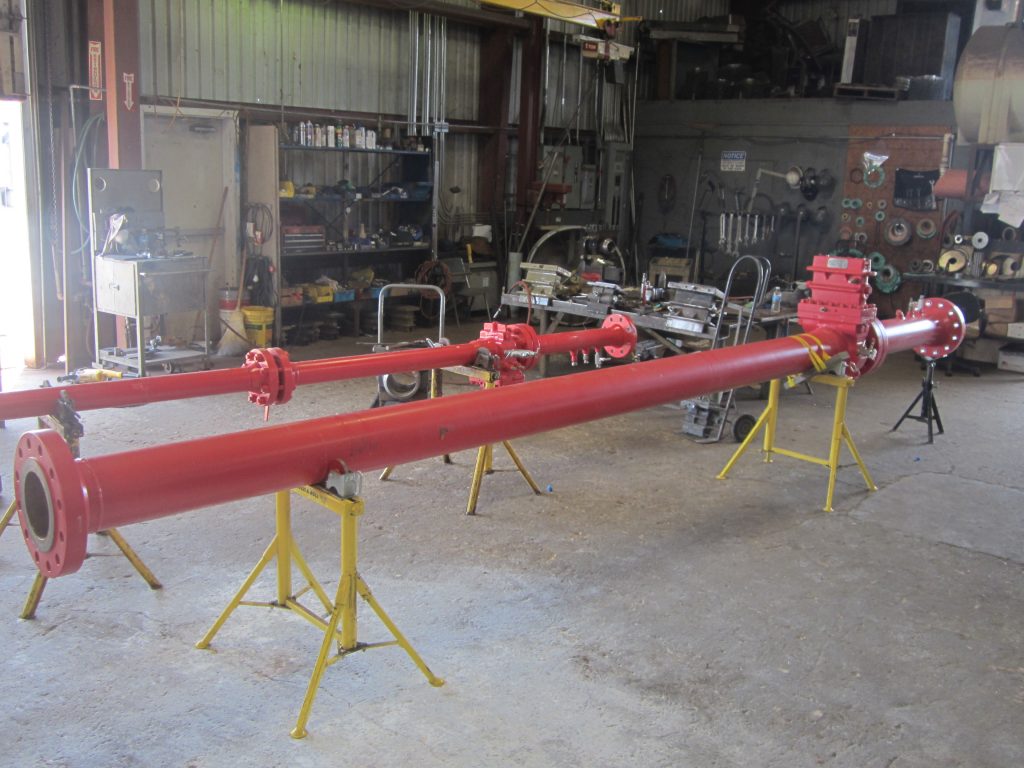
Orifice Metering
An orifice meter is a differential-pressure meter. A thin plate with a precisely bored, sharp-edged opening is held in an orifice fitting or between flanges inside a meter tube. The plate creates a pressure drop, and flow is calculated from that differential pressure together with the line pressure, temperature, and gas properties.
Where It Fits Best
The long-standing workhorse of natural gas measurement. Orifice skids are a cost-effective, well-understood choice where flow stays within a moderate range and some pressure drop is acceptable. Because there are no moving parts, they are straightforward to inspect and service in the field. FAB fabricates orifice meter tubes and repairs orifice meters of all makes, including Daniel, PECO, FMC, Sure Shot, and Canalta.
Advantages
- Thoroughly documented in industry standards and widely accepted
- Low initial equipment cost
- No moving parts; mechanically robust
- Verified by dimensional inspection rather than a flow calibration
- Suits a broad span of pressures, temperatures, and line sizes
Considerations
- Limited turndown compared with other technologies
- Higher permanent pressure loss
- Sensitive to flow profile and pulsating flow; needs a long meter tube or flow conditioner
- Not self-cleaning; the plate can be damaged by excessive flow
Ultrasonic Metering
A multipath ultrasonic meter is a full-bore spool fitted with pairs of transducers and an electronics module. Sound pulses are sent back and forth across the pipe at an angle; pulses traveling with the flow arrive slightly sooner than those traveling against it, and that time difference across several paths gives the average gas velocity.
Where It Fits Best
High-volume, high-pressure gas measurement such as pipeline and transmission meter stations, where the gas is dry and small measurement errors carry a large cost. Ultrasonic meters offer the widest turndown of the common gas meter types.
Advantages
- Very wide rangeability
- Full-bore design adds essentially no pressure drop
- No moving parts and minimal routine maintenance
- Built-in self-diagnostics help flag measurement problems early
- High accuracy
Considerations
- Higher equipment cost and more complex electronics
- Still requires upstream straight pipe or flow conditioning
- Noise from nearby control or pressure-reducing valves can interfere
- Works best on dry gas; liquids or high CO2 content can weaken the signal
Coriolis Metering
A Coriolis meter measures mass flow directly. Fluid passes through one or more vibrating tubes, and the flow causes the tubes to twist slightly. Sensors at the inlet and outlet detect that twist as a phase shift proportional to mass flow, while the vibration frequency also indicates fluid density.
Where It Fits Best
Applications where mass, rather than volume, is what matters, in either liquid or gas service. Because the meter is not affected by flow profile, it fits compact skids where there is little room for straight runs. Coriolis meters are generally offered in smaller line sizes.
Advantages
- Direct mass flow measurement, without separate pressure, temperature, or compressibility corrections
- Not affected by flow profile; no flow conditioner or long straight run required
- No wearing parts
- Wide, linear range and bidirectional measurement
- Density reading doubles as a meter health check
Considerations
- Higher pressure loss, which can limit usable range in gas service
- Generally limited to smaller line sizes
- Sensitive to vibration and pulsation near the tube's operating frequency
- Abrasive particles can erode the tubes; buildup can shift the zero, so periodic zero checks are recommended
Turbine Metering
A turbine meter is a velocity meter. Flow passes through built-in straightening vanes and turns a bladed rotor on precision bearings; the rotor speed is proportional to flow velocity. A pickup counts the blades as pulses, and each pulse represents a known volume based on the meter’s calibration factor (K-factor).
Where It Fits Best
Clean, steady gas or liquid service where good accuracy and repeatability are needed at a moderate cost. In gas service, a turbine meter’s usable range improves as line pressure increases.
Advantages
- Good accuracy and high repeatability across its linear range
- Pulse output acts as a natural totalizer and connects easily to electronic equipment
- Moderate equipment cost
- Integral flow conditioning keeps the upstream straight run relatively short
- Long-established and widely accepted
Considerations
- Requires an initial flow calibration to establish the K-factor
- Rotor and bearings are moving parts that need periodic maintenance
- Not suited to dirty service; an upstream strainer is typically used
- Can be damaged by overspeeding; less effective at very low flow rates
Positive Displacement (PD) Metering
A positive displacement (PD) meter measures volume directly. The flowing liquid moves internal elements, such as gears, pistons, or rotating vanes, that trap and pass a fixed volume with every cycle. Counting the cycles gives the total volume delivered, and the speed of the cycles gives the flow rate.
Where It Fits Best
Liquid measurement where volume is the quantity of record, especially custody transfer of crude oil and other liquid hydrocarbons. PD meters are a common choice on LACT (lease automatic custody transfer) units and handle viscous liquids well.
Advantages
- Measures volume directly, one fixed increment at a time
- High accuracy and wide turndown
- Well suited to viscous liquids
- Little or no straight run or flow conditioning required
- Long, widely accepted history in liquid custody transfer
Considerations
- Pressure drop across the meter can be significant
- Internal moving parts wear over time and need periodic inspection and maintenance
- Close internal clearances can be damaged by debris; upstream straining is commonly used
- Can be larger and heavier than other options in bigger line sizes
Vortex Metering
A vortex meter places a bluff body, often called a shedder bar, across the flow. As the fluid passes it, small swirls called vortices form and break away from alternating sides of the bar. The rate at which they shed is proportional to flow velocity, and a sensor counts them so the meter’s electronics can calculate volumetric flow.
Where It Fits Best
Clean liquid, gas, or steam service with steady flow, where a rugged meter with no moving parts and a simple inline installation is wanted.
Advantages
- No moving parts to wear
- Works on liquid, gas, and steam
- Simple inline installation and relatively low maintenance
- Frequency output proportional to flow, with no separate differential-pressure transmitter
Considerations
- Needs a minimum flow velocity to shed vortices reliably; not suited to very low flows
- Sensitive to pipe vibration
- Requires upstream straight pipe for a well-developed flow profile
- Gas and steam service needs pressure and temperature data to report mass or standard volume
Venturi Metering
A Venturi meter is a differential-pressure meter built as a section of pipe that gradually narrows to a throat and then gradually widens again. Flow is calculated from the pressure difference between the inlet and the throat, along with line pressure, temperature, and fluid properties.
Where It Fits Best
Applications where the simplicity of differential-pressure measurement is wanted but the permanent pressure loss of an orifice plate is not. Venturi meters have long been used for gas flow in pipeline transmission. FAB fabricates Venturi tubes and Venturi meter runs.
Advantages
- Much lower permanent pressure loss than an orifice plate
- No moving parts
- Proven differential-pressure principle with a long history of use
Considerations
- Requires upstream straight pipe, though typically less than an orifice meter
- Longer body than an orifice fitting
- Like all differential-pressure meters, needs pressure, temperature, and fluid data to calculate flow
How the Technologies Compare
| Meter | Measures | Pressure Loss | Rangeability | Straight Run | Moving Parts / Upkeep | Typical Fit |
|---|---|---|---|---|---|---|
| Orifice | Volume, from differential pressure | Higher | Limited | Long meter tube or flow conditioner | None; plate and tube inspection | Cost-effective, proven gas measurement |
| Ultrasonic | Volume, from sound transit time | Essentially none | Very wide | Required | None; built-in diagnostics | High-volume, high-pressure dry gas |
| Coriolis | Mass, directly | Higher | Wide | Not required | None; periodic zero checks | Mass measurement in smaller lines, liquid or gas |
| Turbine | Volume, from rotor speed | Moderate | Medium; better at higher pressure | Short, with integral conditioning | Rotor and bearings; flow calibration | Clean, steady gas or liquid |
| Positive Displacement | Volume, directly in fixed increments | Moderate to higher | Wide | Little or none | Internal moving parts; periodic maintenance | Liquid custody transfer, LACT units |
| Vortex | Volume, from vortex frequency | Moderate | Medium; needs a minimum velocity | Required | None; avoid pipe vibration | Clean liquid, gas, or steam |
| Venturi | Volume, from differential pressure | Lower than orifice | Set by differential pressure range | Required; less than orifice | None | DP measurement with lower pressure loss |
General guidance only. Actual performance depends on the specific meter, line size, fluid, and operating conditions.
Questions That Drive the Choice
- Fluid: gas or liquid, and how clean and dry it is
- Flow range: the turndown needed between minimum and maximum flow
- Pressure drop the system can afford
- Space available on the skid for straight runs
- Whether volume or mass is the quantity of record
- Maintenance expectations and budget, both up front and over time
Built to Your Specification
Whichever meter your application calls for, FAB fabricates the meter run, builds the skid around it, and can supply the flow computers and instrumentation for a complete, turnkey metering package. Need a different technology? We can build around other meter types on request.
We also build regulator skids and LACT units, supply parts and repair kits, and provide field service and meter rebuild and repair.
Send us your specifications and our team will put together a quote.
Need a Metering Skid?
Request a quote or call 713-748-0799 or toll-free 800-227-6944. After-hours emergency service is available at 713-748-0799.
